Why transport on Lanzarote is different
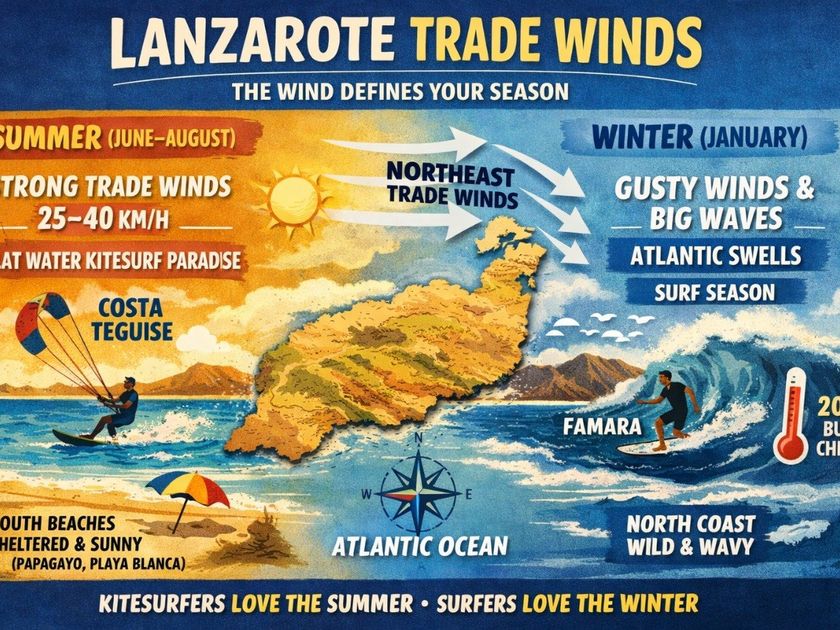
Lanzarote is a small island — you can drive from the southern tip at Playa Blanca to the northern tip at Órzola in under an hour. But "small" doesn't mean "easy to get around without planning." The island's main attractions are scattered across all three coasts and the volcanic interior, there are no trains or trams, and the wind — the alisio trade wind that blows from the northeast year-round — turns what looks like a pleasant 15-minute cycle into a 45-minute grind.
If you're staying in one resort and only want the beach, you can manage with buses and taxis. If you want to see Timanfaya, the north coast, La Geria wine country, the Jameos del Agua, and the restaurants that locals actually go to — you need a car. The good news: driving in Lanzarote is straightforward, the roads are good, and parking is almost always free and easy.
Rental cars
A rental car is the single best decision you can make on Lanzarote. The island was practically designed for driving — good roads, light traffic outside Arrecife, free parking almost everywhere, and distances of 15–40 minutes between anything worth seeing. You don't need a 4×4. A standard economy car handles every road on the island, including the dirt track to Papagayo (if you drive slowly).
The three local companies (use these)
The three Canarian rental companies dominate the island for good reason. They're cheaper, faster, and have far larger fleets than the international brands. All three have desks at the airport and offices in the main resorts.
- CICAR — the biggest. Family-run since 1965. No credit card required (they take a cash deposit or a card pre-authorisation). Simple insurance included. No hidden fuel charges — they give you a full tank and you return it full. Desks at the airport, Puerto del Carmen, Costa Teguise, Playa Blanca. Their online booking system works. This is the one most locals and residents use.
- Cabrera Medina — the second biggest, also Canarian. Similar model to CICAR, slightly newer fleet. Good online prices, sometimes cheaper than CICAR in low season. Desks at the airport and all main resorts. Reliable, no tricks.
- Autoreisen — German-run but Canarian-based, the oldest car hire company on the island. Tends to have slightly higher prices but very well-maintained fleets and excellent customer service. Popular with German visitors. Good if you want a no-surprises experience and don't mind paying a bit more.
The international brands (and aggregators)
Goldcar, Hertz, Avis, Sixt, Enterprise — they all have desks at the airport. They are often more expensive than the local three, and several have a reputation for aggressive upselling (insurance, fuel, additional drivers). If you book through an aggregator like DiscoverCars, read the fine print — the headline price rarely includes full insurance and the desk will try to sell you more.
What to avoid
- Fuel scams: The local three operate "full to full" — you get the car with a full tank, return it full. Avoid any company that gives you the car full and charges you for a tank at a premium rate, expecting you to return it empty. You'll pay €60–€80 for €40 of fuel.
- Insurance pressure: The international desks will try to sell you their "super cover" for €15–€25/day on top of your booking. The local three include basic insurance in the price. Check your travel insurance and your credit card cover before you buy extras.
- Debit vs credit card: Some international brands require a credit card in the main driver's name and place a large hold (€800–€1,200). CICAR accepts debit cards and the hold is smaller. This matters if you don't have a credit card.
- "Free" additional drivers: Cabrera Medina and CICAR include one additional driver free on many bookings. International brands charge €5–€8/day per extra driver.
Driving in Lanzarote — what you need to know
Driving here is genuinely easy. The roads are well-maintained, the traffic is light outside Arrecife and the rush hours, and the signage is clear. But there are a few things that catch people out:
- Roundabouts: Lanzarote has a lot of roundabouts, especially on the LZ-2 between Arrecife and Playa Blanca and the approach roads to the resorts. The rule is simple: give way to traffic already on the roundabout, indicate when exiting. Locals use the left lane for straight on and the right lane for the first exit — the opposite of what some northern European drivers expect. Watch the cars around you.
- Parking: Free and easy almost everywhere. The only places you'll struggle are the centre of Arrecife (use the underground car park by Charco de San Ginés), the Papagayo dirt road in peak summer (the barrier closes when full), and Puerto del Carmen's Avenida de las Playas in August. Everywhere else, just pull up.
- The wind: It doesn't affect driving much in a car, but on a motorbike or scooter it's a real factor. In a car, the main wind-related issue is that on the LZ-1 north of Arrieta and the LZ-10 down to Famara, strong gusts can push a high-sided vehicle. In a normal car it's fine.
- Dirt roads: The only significant one is the track to Papagayo (6 km, bumpy but manageable at low speed). There's also a rough track to Los Charcones near Playa Blanca — drive it very slowly or park and walk. Your rental agreement may say "no unpaved roads" — check, and if in doubt, walk the last stretch.
- Speed limits: 50 km/h in towns, 80–90 km/h on main roads, 120 km/h on the short stretch of the LZ-20 dual carriageway. There are speed cameras on the LZ-2 and the approach to Arrecife. Don't speed — the fines are real and the rental company will add an admin fee.
- Drink-driving: The limit is 0.5 g/l (lower than the UK's 0.8). The Guardia Civil does roadside checks, especially on weekends and summer nights. Don't risk it.
Buses — Lanzarote Bus
The bus network is called Lanzarote Bus (also known by its old name, Arrecife Bus). It's run by the municipal company and it's better than most visitors expect. The buses are modern, air-conditioned, mostly on time, and cheap. The network covers the three main resorts (Puerto del Carmen, Costa Teguise, Playa Blanca) and Arrecife well. It does not reach Timanfaya, La Geria, most of the north coast, or the more remote beaches.
The lines you'll actually use
Arrecife ↔ Puerto del Carmen
The workhorse. Runs every 20–30 minutes, 06:00–23:00. The most frequent and reliable line on the island. Connects the capital with the biggest resort. ~25 minutes.
Arrecife ↔ Puerto del Carmen (via hospital)
Slightly different routing, less frequent than the 22. Useful if you're near the hospital area or the southern end of Puerto del Carmen.
Arrecife ↔ Costa Teguise
Connects the capital to Costa Teguise via the airport road. Runs roughly every 30 minutes during the day. ~20 minutes.
Arrecife ↔ Teguise ↔ Caleta de Famara
The north line. Runs roughly every 2 hours (less on Sundays). This is how you get to Famara and the north coast without a car. Check the app — times change seasonally.
Arrecife ↔ Airport ↔ Puerto del Carmen
The airport bus. Runs every 30 minutes during the day, less frequently in the evening. Connects César Manrique Airport directly with Puerto del Carmen via Arrecife. The cheapest way from the airport — about €1.40 to Arrecife, €3.50 to Puerto del Carmen.
Arrecife ↔ Yaiza ↔ Playa Blanca
The south line. Runs roughly hourly. Connects Arrecife to Playa Blanca via Yaiza in about 45–50 minutes. The main public transport link to the southern resort.
What the bus can't do
- No service to Timanfaya National Park — you need a car, taxi, or organised tour.
- No service to La Geria wine route or the individual bodegas.
- Limited service to the north coast beyond Famara — no buses to Órzola, Punta Mujeres, or Arrieta on a regular schedule (you can get to Órzola via Line 7 in summer, but it's infrequent).
- No late-night service — last buses on most lines leave by 23:00.
- Luggage space is limited — fine for a backpack, tight for a full suitcase.
Taxis
Lanzarote's taxis are white with a green light on the roof and a "TAXI" sign. They're official, regulated, metered, and generally honest. There are taxi ranks at the airport, in every resort centre, at the main bus station in Arrecife, and outside the larger hotels. You can also flag them on the street in the resorts, or call the local taxi rank.
Approximate fares to main destinations
| Route | Approx. fare |
|---|---|
| Airport ↔ Puerto del Carmen | €15–€20 |
| Airport ↔ Costa Teguise | €15–€20 |
| Airport ↔ Arrecife centre | €8–€12 |
| Airport ↔ Playa Blanca | €35–€45 |
| Puerto del Carmen ↔ Playa Blanca | €30–€40 |
| Puerto del Carmen ↔ Costa Teguise | €20–€25 |
| Arrecife ↔ Timanfaya (one way) | €35–€45 |
| Arrecife ↔ Caleta de Famara (one way) | €35–€45 |
Fares are approximate — the meter decides. Expect slightly higher fares at night, on Sundays, and on public holidays.
Taxi ranks
- Airport — outside arrivals, 24/7. There's always a queue of taxis.
- Arrecife — at the bus station (Estación de Guaguas), by Charco de San Ginés, and by the Marina.
- Puerto del Carmen — along the Avenida de las Playas at several points, and at the old town harbour (Varadero).
- Costa Teguise — at the Las Cucharas centre and by the main hotels.
- Playa Blanca — at the port (Marina Rubicón) and the town centre.
Bicycles and e-bikes
Cycling in Lanzarote is increasingly popular, and the island is better for it than most people expect — rolling hills, good tarmac on most roads, light traffic outside the resorts, and dramatic scenery. Road cycling is well established here; the island hosts a professional training destination in winter. Mountain biking is possible on the dirt tracks through La Geria and the north coast.
Rentals
There are bike rental shops in Puerto del Carmen, Costa Teguise, and Playa Blanca. Most offer road bikes, hybrids, and e-bikes. Expect €20–€35/day for a decent hybrid, €30–€50/day for an e-bike, €25–€45/day for a road bike. Weekly rates are better. Helmets are legally required on all roads outside urban areas.
Routes
- La Geria wine route: The classic. Arrecife → Uga → La Geria → Yaiza. Rolling roads through the volcanic wine country, past dozens of bodegas. About 30–40 km round trip from Puerto del Carmen. Relatively sheltered from the wind by the volcanic cones. Stop at a bodega for a glass.
- Puerto del Carmen to Arrecife: Flat coastal ride on the old road, about 10 km each way. Good for a half-day out.
- Costa Teguise loop: A gentle 15 km loop around Costa Teguise and the coast. Good for families.
- Arrecife to Teguise: 15 km inland climb to the old capital. Harder than it looks — it's uphill and exposed.
- North coast: Beautiful but remote. The LZ-1 to Órzola is a long, exposed ride with the wind in your face on the way north and at your back on the way south. Not for beginners.
When cycling is bad
- Strong wind days: If the forecast shows 30+ km/h, don't bother on a regular bike. It's miserable and potentially dangerous on exposed roads.
- Calima: Air quality is poor; don't exert yourself.
- Midday in summer: 35°C+ and no shade on most roads. Go early morning (07:00–09:00) or after 18:00.
- The LZ-2 dual carriageway: Avoid it. Use the old parallel road instead — it's quieter and more scenic.
Walking
Walking within the resorts is fine — Puerto del Carmen's Avenida de las Playas is a flat 1.5 km promenade, Costa Teguise is compact, and Playa Blanca has a seafront promenade stretching from the marina to the lighthouse. If you're staying in any of these, you can walk to restaurants, beaches, and shops within 15 minutes.
Walking between towns, however, is not practical. The distances are large and the roads between towns are fast, with little or no shoulder. Here's the reality:
- Puerto del Carmen to Arrecife: 8 km on the main road. Not pleasant. Take the bus (Line 22).
- Costa Teguise to Arrecife: 6 km. Same — take the bus (Line 4).
- Playa Blanca to Yaiza: 12 km on the LZ-2. Drive or take the bus.
- Puerto del Carmen to Costa Teguise: 10 km via Arrecife. Drive.
- Within Playa Blanca: Everything walkable in 20 minutes — the marina, the beaches, the town centre.
- Within Puerto del Carmen: The old town to the far end of the strip is about 3 km along the promenade. Pleasant if you like walking.
Scooters and mopeds
Scooters are available for rent in the main resorts — you'll see shops in Puerto del Carmen, Costa Teguise, and Playa Blanca. Prices run around €25–€35/day. They're fun, cheap to run, and easy to park. For getting around a single resort or doing a short coastal run, they work well.
But I'd be dishonest if I didn't say: the wind makes scooters a much worse option than they look. The alisio catches a scooter like a sail, and on the open roads between towns — the LZ-1 north, the LZ-2 south — gusts can genuinely push you across the lane. The roads between towns are also faster than they look, and the volcanic gravel that blows onto the bends is slippery. If you've never ridden a scooter before, Lanzarote is not the place to learn.
