Why Lanzarote

Not just another sunny island. This is the place where volcanoes meet the sea, where wine grows from ash, and where people come for a week and come back three times.

Timanfaya National Park volcanic landscape

Walk on a planet that isn't Earth

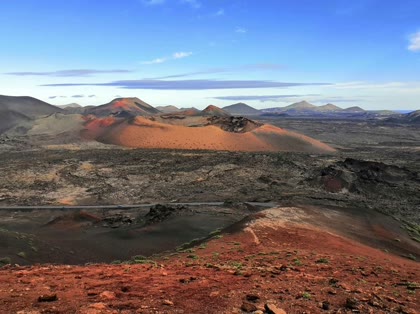
Between 1730 and 1736, Lanzarote lived through one of the most spectacular volcanic eruptions in recorded history. For six continuous years, more than 30 volcanoes tore open the earth across the western half of the island. Entire villages were swallowed. The landscape was buried under lava and ash. What the eruption left behind is a 200 km² black desert that looks more like Mars than anything on this planet — and it's the reason NASA studied this terrain.

Today, that desert is Timanfaya National Park. You can drive the Volcano Route through the heart of it, walk the Tremesana Trail with a guide who explains the geology beneath your feet, or hike around craters like Montaña Cuervo and Montaña Colorada. At Islote de Hilario, the ground is still so hot 5 metres down that water poured into a bore hole erupts as a geyser and dry brush ignites in seconds. The restaurant El Diablo, designed by César Manrique, cooks food using the earth's own heat.

And when the sun drops, the red craters truly ignite — the rock turns copper, then crimson. Book the evening tour and you'll have dinner on a volcano while the sky burns. There is nothing else like this in Europe.

C01
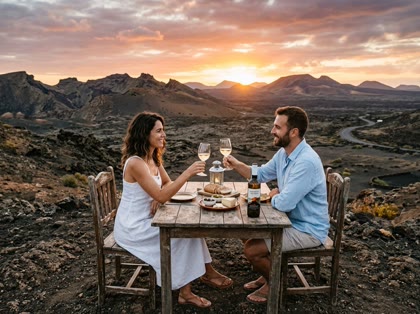
La Geria vineyard in volcanic ash at sunset

Drink wine born from a volcano, at sunset, in the ash

After the eruptions buried a quarter of the island under volcanic ash (lapilli), Lanzarote's farmers did something extraordinary. Instead of abandoning the land, they invented a way to grow vines in it. Each vine is planted in a individual hole dug into the black ash, 3 metres deep, and shielded by a semicircular dry-stone wall called a zoco that protects it from the relentless trade winds. The ash acts as a sponge, trapping moisture from the night dew and channelling it to the roots. No irrigation needed. The FAO recognised this system in 2025 as a Globally Important Agricultural Heritage System (GIAHS).

The result is La Geria — a protected landscape of thousands of circular vines stretching across black volcanic soil beneath the silhouette of cones. It's been called the most beautiful vineyard in the world. The wine it produces is Malvasía Volcánica, a grape variety that exists nowhere else, with a Denominación de Origen of its own. Crisp, mineral, slightly smoky — it tastes like the ground it comes from.

You can visit bodegas like El Grifo (founded in 1775, the oldest in the Canaries), La Geria, or Los Bermejos. Many offer sunset tastings with local cheese and artisan chocolate, the black cones turning amber behind the vines. Some evenings there are tapas under the stars with live music. It's the most surreal food and wine experience you'll ever have — and it only exists because a volcano tried to destroy everything.

C02
Surf and kitesurf in Lanzarote

The island of wind: surf, kitesurf and Atlantic adrenaline

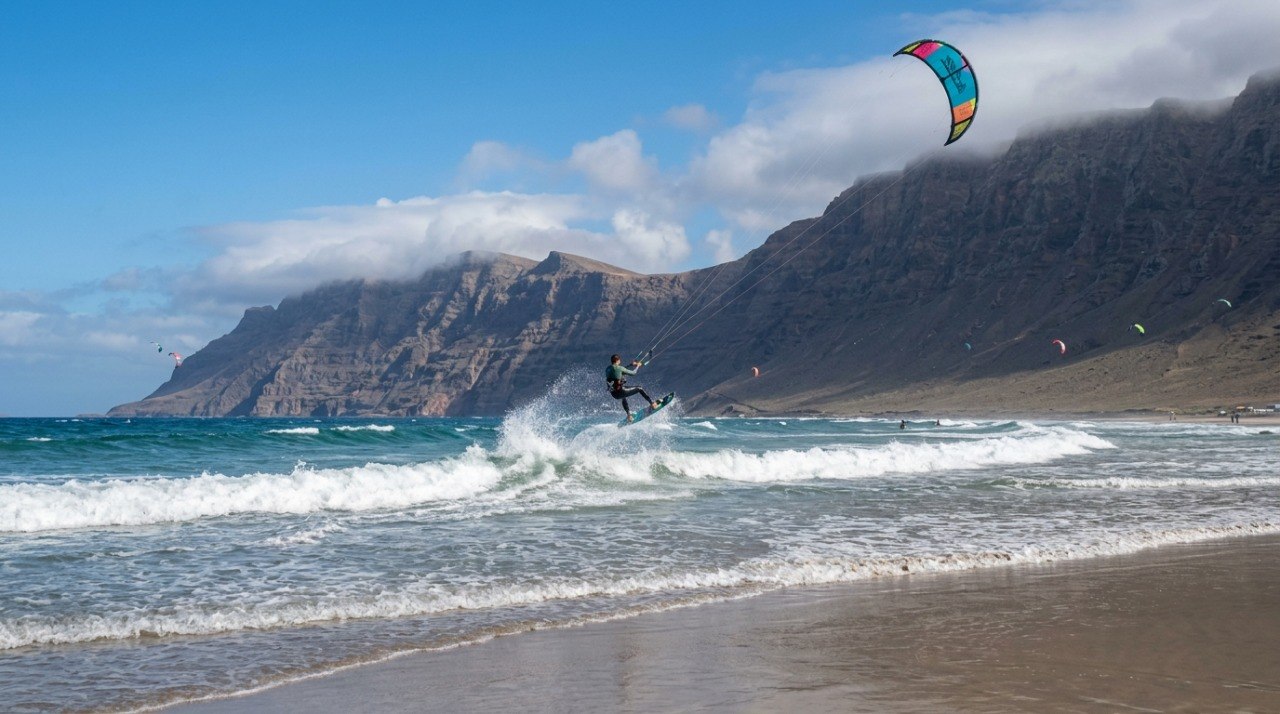
The trade winds blow almost constantly across Lanzarote, and that single fact shapes life here more than almost anything. In the north, Caleta de Famara is the surf capital of the Canary Islands. Six kilometres of golden sand backed by 400-metre cliffs, with Atlantic swells that work for beginners and advanced surfers alike. Surf schools have been running here since 1996 — three decades of experience, real surf culture, not a beach club pretending to be cool. You can book a lesson, a week-long camp, or just rent a board and paddle out.

In Costa Teguise, the same trade winds make it one of Europe's top kitesurf spots. The lagoon is shallow and flat, perfect for learning, while further out the wind kicks up enough for experienced riders. Wingfoil has exploded here in recent years too. And if being underwater is more your thing, Lanzarote offers diving with up to 30 metres of visibility, reef dives, cave dives, and snorkelling routes where you can swim alongside turtles at Playa Chica or the Atlantic Museum — Europe's first underwater sculpture museum, created by Jason deCaires Taylor.

You can also paddleboard at sunrise, kayak into sea caves along the southern coast, or try paragliding from the Famara cliffs. If you need to move, Lanzarote makes it easy — and the wind makes sure you never get bored.

C03
Beaches you haven't seen on Instagram

Beaches you haven't seen on Instagram

Lanzarote doesn't do ordinary beaches. At El Golfo, the sand is black and fine, crushed from volcanic rock by centuries of Atlantic waves. A few metres away, the Charco de los Clicos is a small emerald-green lagoon sitting inside a half-crater right next to the open ocean — the contrast between green and blue against black rock is one of the most photographed spots on the island. The green comes from algae fed by minerals in the volcanic rock.

In the north, Famara stretches 6 kilometres of golden sand beneath towering rust-coloured cliffs. Surfers share the beach with families, walkers, and locals who come just to watch the sunset. It never feels crowded because it simply can't — the scale is too big. In the south, the Papagayo beaches are a chain of golden coves hidden between headlands of volcanic rock, reachable by a short walk or a dirt track. The water is calm and transparent. In the east, Playa Chica in Puerto Calero is a tiny protected bay perfect for snorkelling.

What makes Lanzarote's beaches different isn't just how they look — it's that each one is a completely different world. Black, green, gold, white sand. Wild Atlantic surf or glass-calm lagoons. Cliffs, dunes, lava formations. If you've seen one beach here, you've seen exactly one beach.

C04
Eat like a local, not like a tourist

Eat like a local, not like a tourist

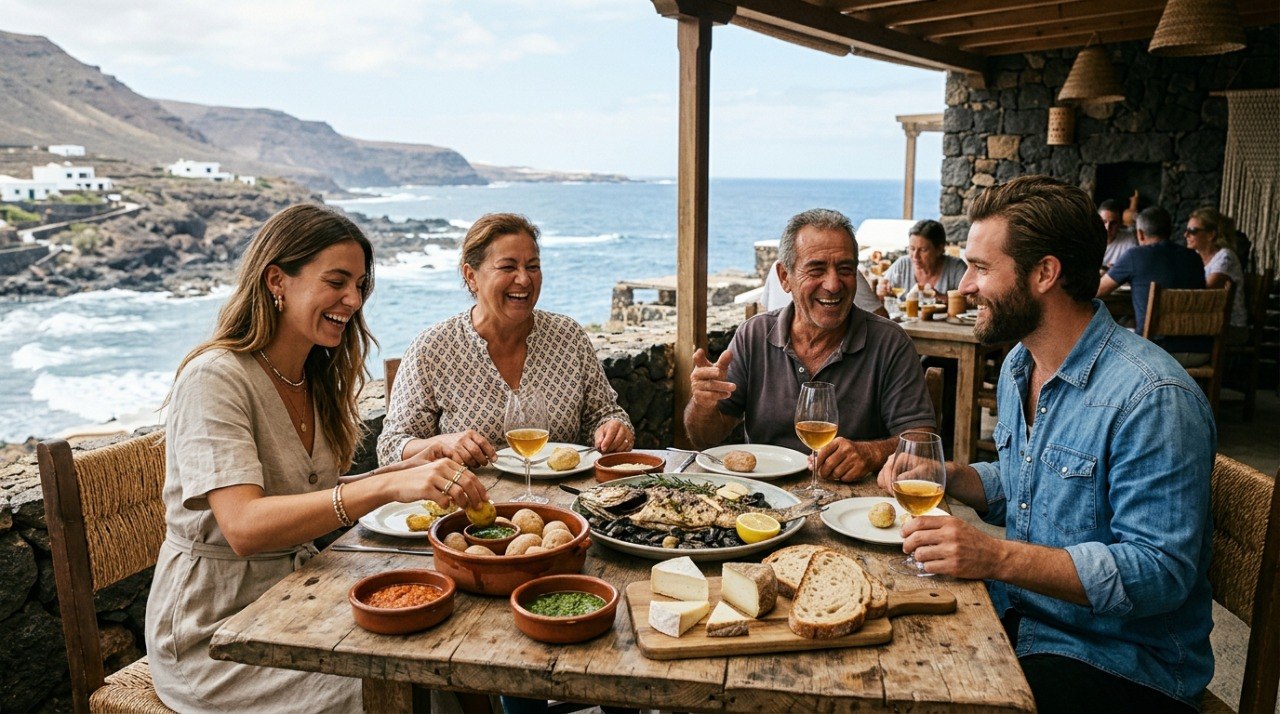
Canarian food is not Spanish food. It's its own thing — shaped by the Atlantic, Africa, and centuries of making do with what the island gives you. The foundation is papas arrugadas: small local potatoes boiled in heavily salted water until the skin wrinkles, served with mojo. Mojo comes in two types — verde (green, made with coriander, garlic, cumin and oil) and picón (red, with red pepper and chilli). You tear a potato open with your fingers, dip it in both mojos, and you understand immediately why this dish has survived for hundreds of years.

Then there's the fish. Lanzarote is a fishing island — cherne (wreckfish), sama (red sea bream), vieja (parrotfish) and bocinegro (red mullet) arrive at the market daily. The Canarian way is whole, grilled over charcoal, with a drizzle of oil, garlic and vinegar. Nothing more. Sancochado is the local fish stew, simple and powerful. Gofio — toasted barley or wheat flour — has been the staple carbohydrate since before the Spanish arrived; locals mix it with milk, fish broth, or knead it into dough. Queso de cabra (goat cheese) from the island ranges from soft and fresh to aged and smoked.

The best places to eat aren't always the ones with the best reviews online. They're the guachinches — informal, family-run places, often someone's garage or terrace, serving whatever they caught or cooked that day. Ask a local where they eat. That's where you want to be.

C05
Sunsets that change your day in Lanzarote

Sunsets that change your day (and maybe your life)

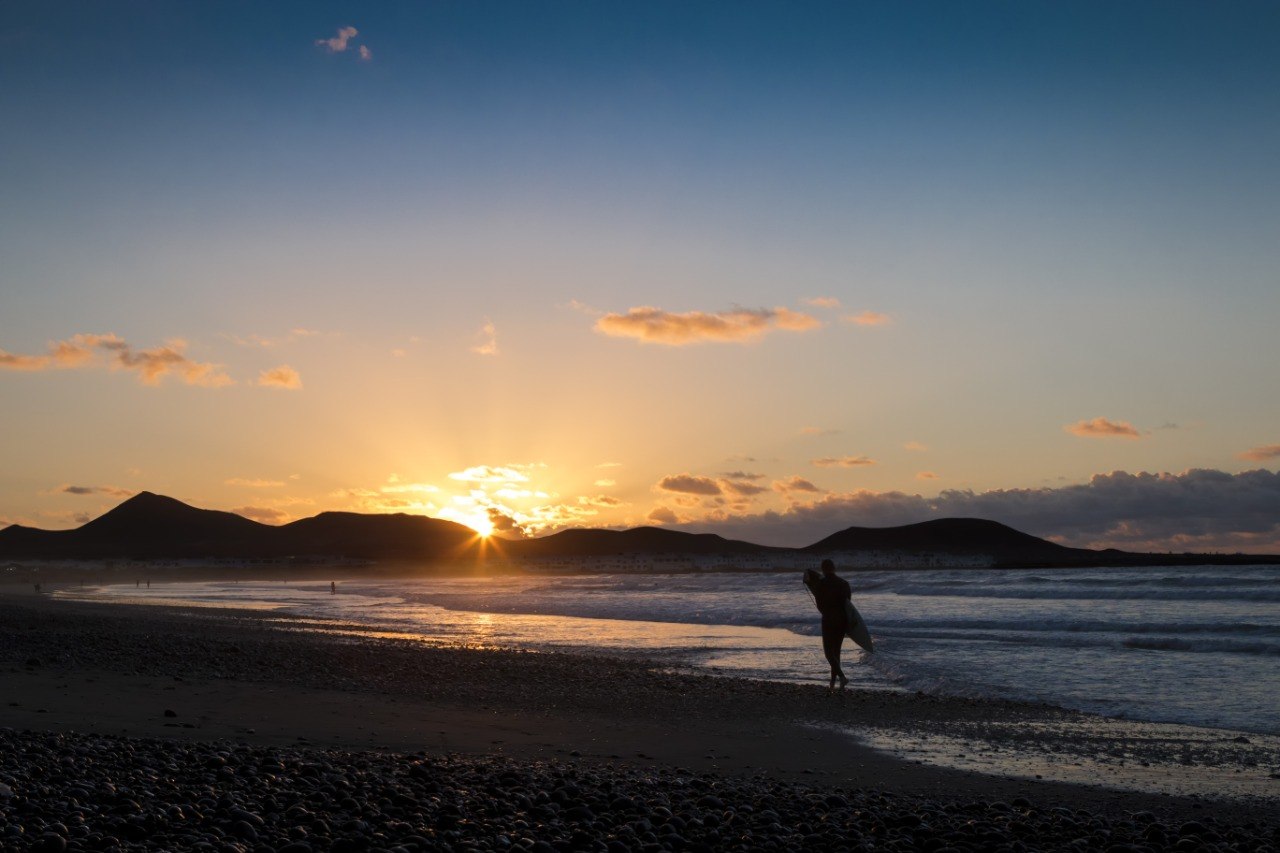
Famara at sunset is practically a local ritual. Every evening, dozens of people walk down to the sand — some with surfboards under their arm after the last session, others with a cold beer from the Spar, others with nothing at all — and they just sit. The sun drops behind the ocean in a way that seems impossibly slow and impossibly fast at the same time. The Famara cliffs catch the light and turn from grey to gold to deep amber. Seagulls glide in silence on the thermals. The Atlantic swell keeps rolling in. Nobody talks much. Nobody needs to.

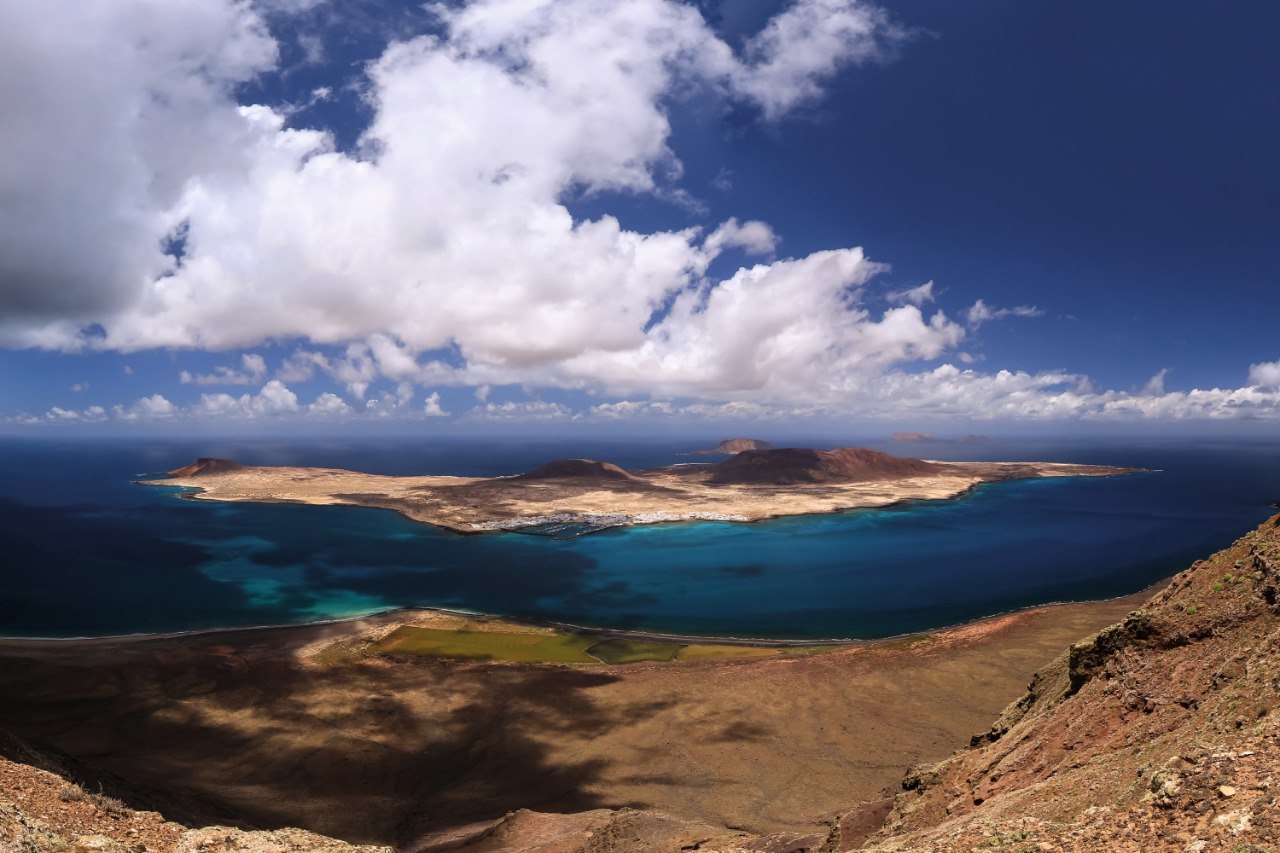
And Famara is just the beginning. The volcanoes of Timanfaya at sunset turn blood-red — the black rock absorbs the last light and glows. La Geria at sunset silhouettes the vine pits and stone walls against a sky of molten copper. El Charco de los Clicos at sunset turns the green lagoon an impossible shade of jade against a burning sky. The Mirador del Río at sunset gives you the entire Chinijo archipelago laid out below in shadow while the horizon blazes.

Every sunset here is different, and every sunset is an event. Come for a week and you'll have seven completely different ones. Come back and you'll start chasing them.

C06
La Graciosa: the island with no cars where time stopped

La Graciosa: the island with no cars where time stopped

La Graciosa is a 29 km² island off the northern coast of Lanzarote — the largest of the Chinijo Archipelago, which also includes the uninhabited islets of Alegranza, Montaña Clara, and the Roques del Este and Oeste. In 2018 it was officially recognised as the 8th inhabited Canary Island, though most tourists have never heard of it. You get there on a 25-minute ferry from Órzola.

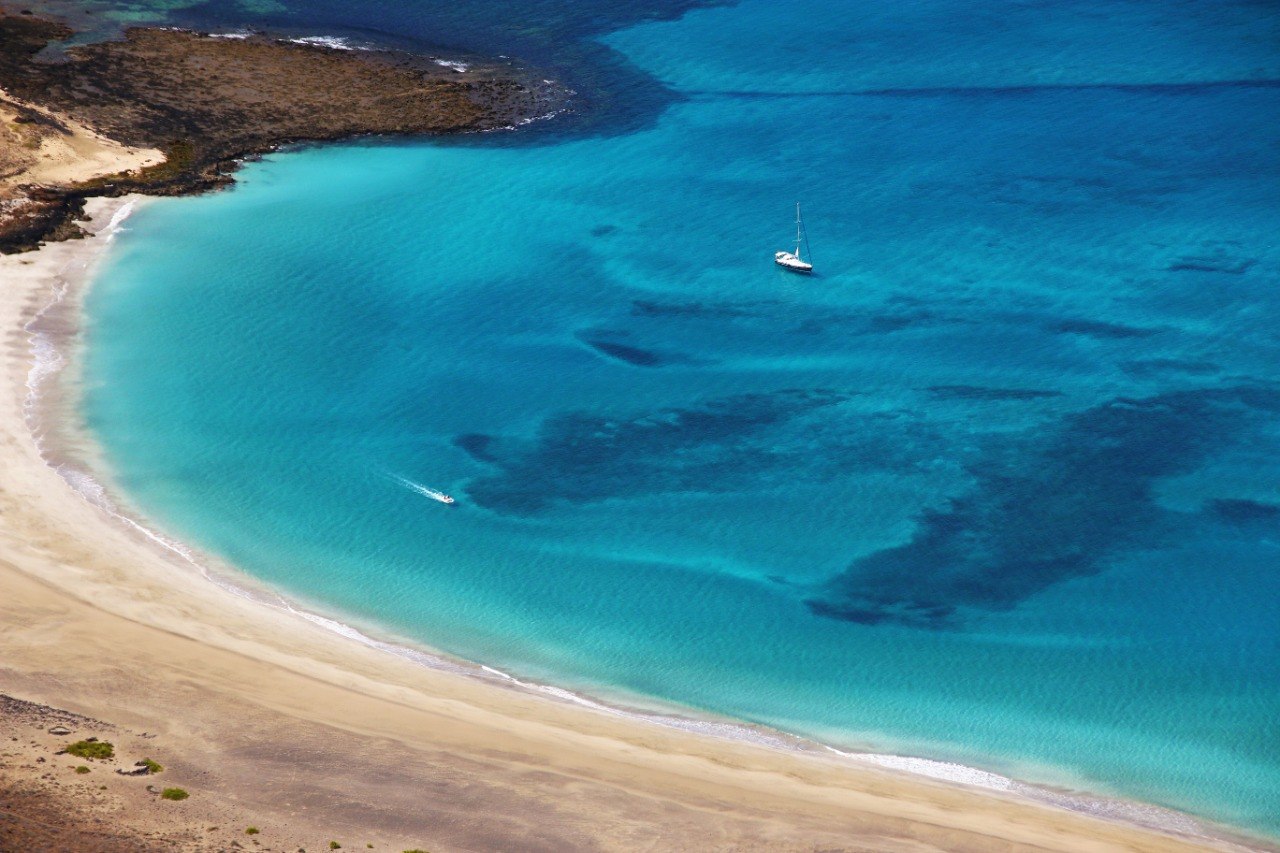
There are no paved roads. No traffic lights. No taxis. The two villages — Caleta de Sebo and Pedro Barba — have sandy streets you walk or cycle. The beaches are what surprise people. Playa de las Conchas is a kilometre of untouched white sand with turquoise water, backed by the dormant volcano Montaña Amarilla. Playa de la Francesa is calmer, more protected, with water so clear you can see the bottom. Playa del Risco, at the foot of Lanzarote's cliffs, is reachable only by boat or a long walk — and you'll likely have it to yourself.

The Chinijo Archipelago is a Marine Reserve, so the waters around La Graciosa are rich with life — dolphins, turtles, and over 90 species of seabirds nest on the nearby cliffs. Day-trippers come on catamarans with lunch and open bar, but the real magic is staying overnight, when the last ferry leaves and the island empties. You eat fresh fish at a harbour restaurant, walk to the beach for a sunset with maybe ten other people, and fall asleep to nothing but the sound of the ocean. It's like travelling 50 years back in time.

C07
Stars you didn't know existed

Stars you didn't know existed

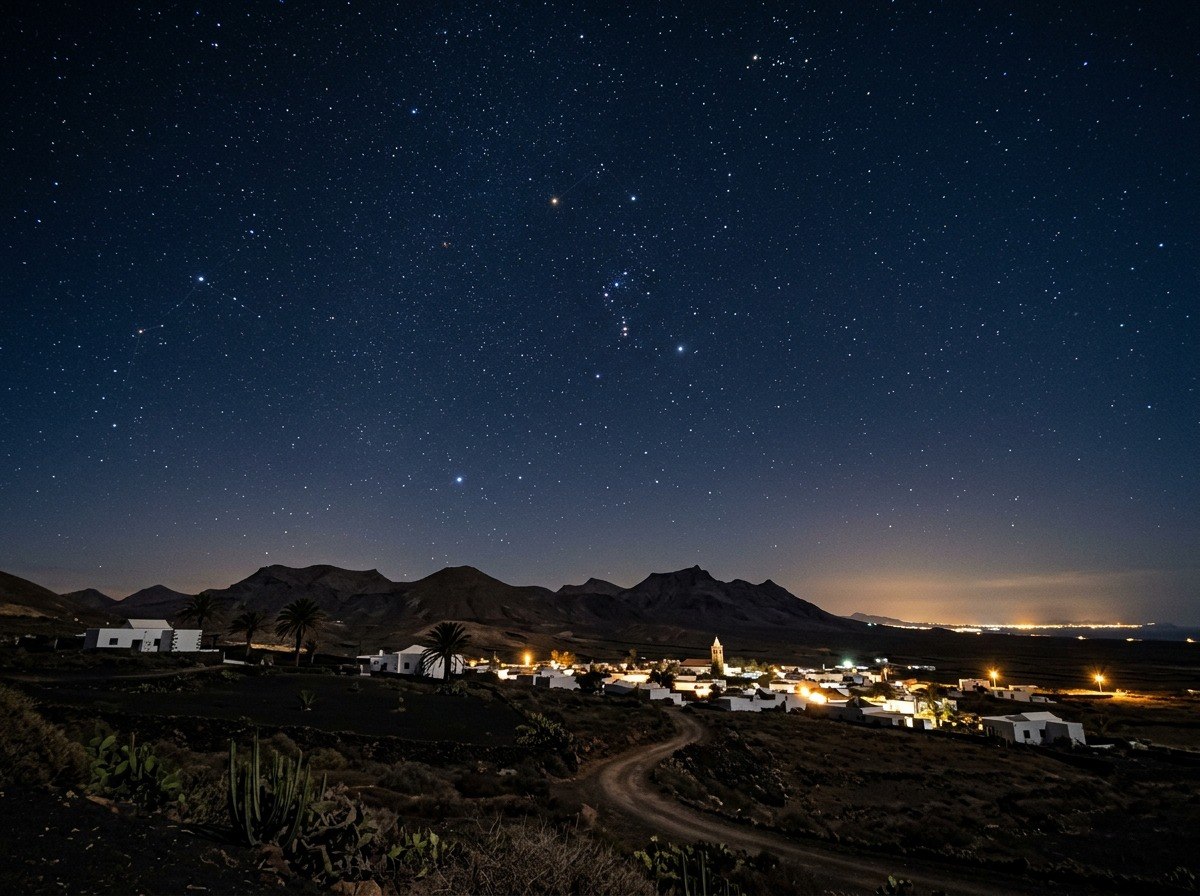
The Canary Islands are recognised as one of the best destinations in the world for stargazing — the combination of latitude, stable atmospheric conditions, and low light pollution creates skies of exceptional clarity. Lanzarote, being small and largely undeveloped, has almost no artificial light outside the main resort towns. Drive 15 minutes from Puerto del Carmen and you're under a sky that most Europeans haven't seen since childhood.

The Milky Way is visible to the naked eye on most clear nights — not as a faint smudge, but as a bright river of light across the sky. Several companies run guided stargazing excursions that take you to dark spots in the volcanic interior, provide telescopes, and walk you through constellations, planets, and deep-sky objects. Seeing Saturn's rings or Jupiter's moons through a telescope while lying on the slope of a dead volcano is the kind of experience that leaves you silent for a while.

The best nights are around new moon, obviously, but even a half moon over the caldera of Timanfaya has its own magic. If you're into astrophotography, Lanzarote's volcanic foregrounds — silhouetted cones, twisted lava, empty horizons — make for compositions you won't find anywhere else in Europe. Bring a tripod and a wide-angle lens. Or just bring a blanket and look up.

C08
The island one artist turned into a masterpiece

The island one artist turned into a masterpiece

César Manrique was born in Arrecife in 1919. He left Lanzarote to study and exhibit in Madrid and New York, and by the late 1960s he was an established artist with an international reputation. He could have stayed anywhere. He came back — and he came back with a mission. Lanzarote in the 1960s was beginning to feel the pressure of mass tourism. Tenerife and Gran Canaria had already been transformed by concrete towers and roadside billboards. Manrique decided his island was not going to follow.

He lobbied the island government relentlessly. The result was a set of regulations that still stand today: no building taller than three storeys, no roadside advertising, all houses painted white with green or brown woodwork. He designed spaces that proved architecture could integrate with nature rather than dominate it — Jameos del Agua (a cave within an active volcanic tube connected to the sea, turned into a concert hall and restaurant), Mirador del Río (a viewpoint carved into the cliff face, almost invisible from outside), Jardín de Cactus (an old quarry transformed into a cactus garden), and his own house built over five volcanic bubbles underground.

He died in a car crash in 1992, near the Fundación that bears his name. But his philosophy is embedded in law now. Lanzarote is the only island in the world where one man's vision of how things should look became the rule for everyone. No high-rises, no billboards, white and green. And every person who visits and says "this island is beautiful" is, whether they know it or not, looking at Manrique's work.

C09
The vibe: the island where your stress disappears

The vibe: the island where your stress disappears

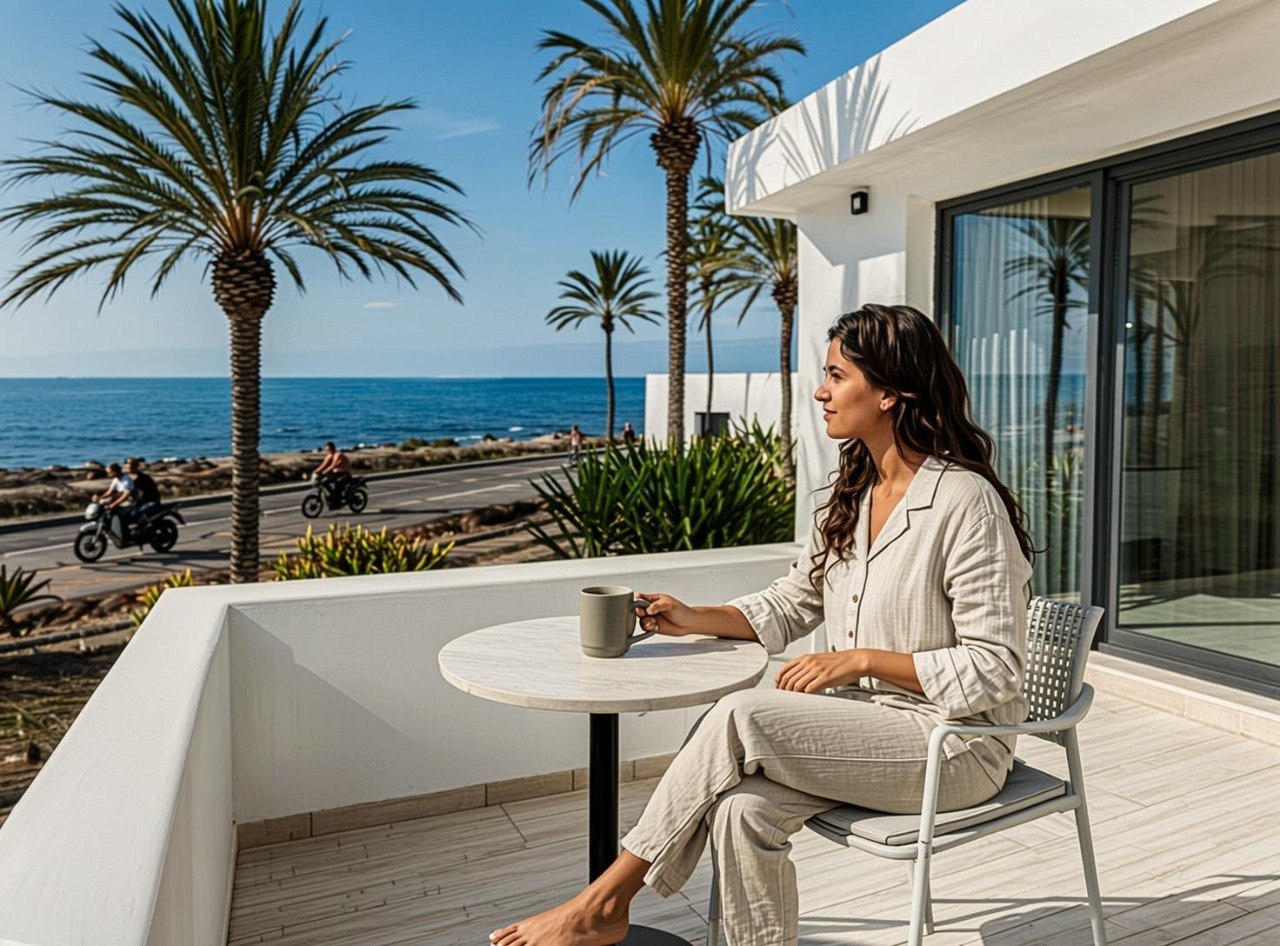
There's something about Lanzarote that doesn't show up in guidebooks. People come for a week and end up coming back three, four, five times. It's not the weather, though that helps. It's not the volcanoes, though they're extraordinary. It's a feeling — the rhythm of the island is fundamentally different from the mainland, or from the bigger Canary Islands. Things move slowly here. The locals are warm and straightforward. The island is small enough that you can drive anywhere in 40 minutes, but varied enough that you could explore for months and still find new places.

It's attracted a growing community of digital nomads and remote workers — coliving spaces like Pitaya in Arrecife, Coworksurf in Famara, and Coworking Guru have sprung up, offering high-speed internet and a community of people who chose to work where others holiday. Art retreats like The Sun Collective run workshops in painting and creativity in volcanic villas. Yoga studios, breathwork sessions, and wellness retreats sit alongside surf camps and dive centres. There's a creative, healthy, low-key energy here that doesn't try too hard.

The island isn't mass-tourism-free — Puerto del Carmen and Playa Blanca have their resort strips. But step outside those zones and Lanzarote reveals itself as something rare: a place that chose to protect its identity instead of selling it. It's the anti-Tenerife, the anti-Benidorm, the anti-everything that made you hate package holidays. It's where you go when you no longer need to be entertained — you just need to be.

C10