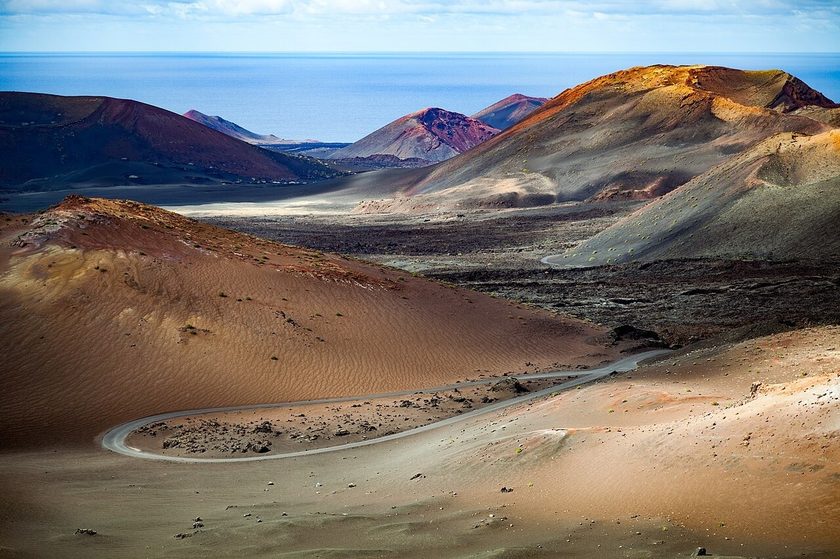
Timanfaya volcanic landscape Lanzarote — rust-red mountains and lava fields under dramatic cloudy sky at the Fire Mountains National Park

10 places that make Lanzarote unlike anywhere else

Volcanoes you can walk into. Caves turned into concert halls. Vineyards growing on black ash. This is what you're actually coming for.

Timanfaya National Park Lanzarote — rust-red volcanic crater landscape with Fire Mountains route under bright blue skyquot;article-img placeholder p-volcanoTimanfaya National Park Lanzarote — rust-red volcanic crater landscape with Fire Mountains route under bright blue skyquot;>quot;ph-iconTimanfaya National Park Lanzarote — rust-red volcanic crater landscape with Fire Mountains route under bright blue skyquot;>🌋
'">

Timanfaya National Park — the Fire Mountains

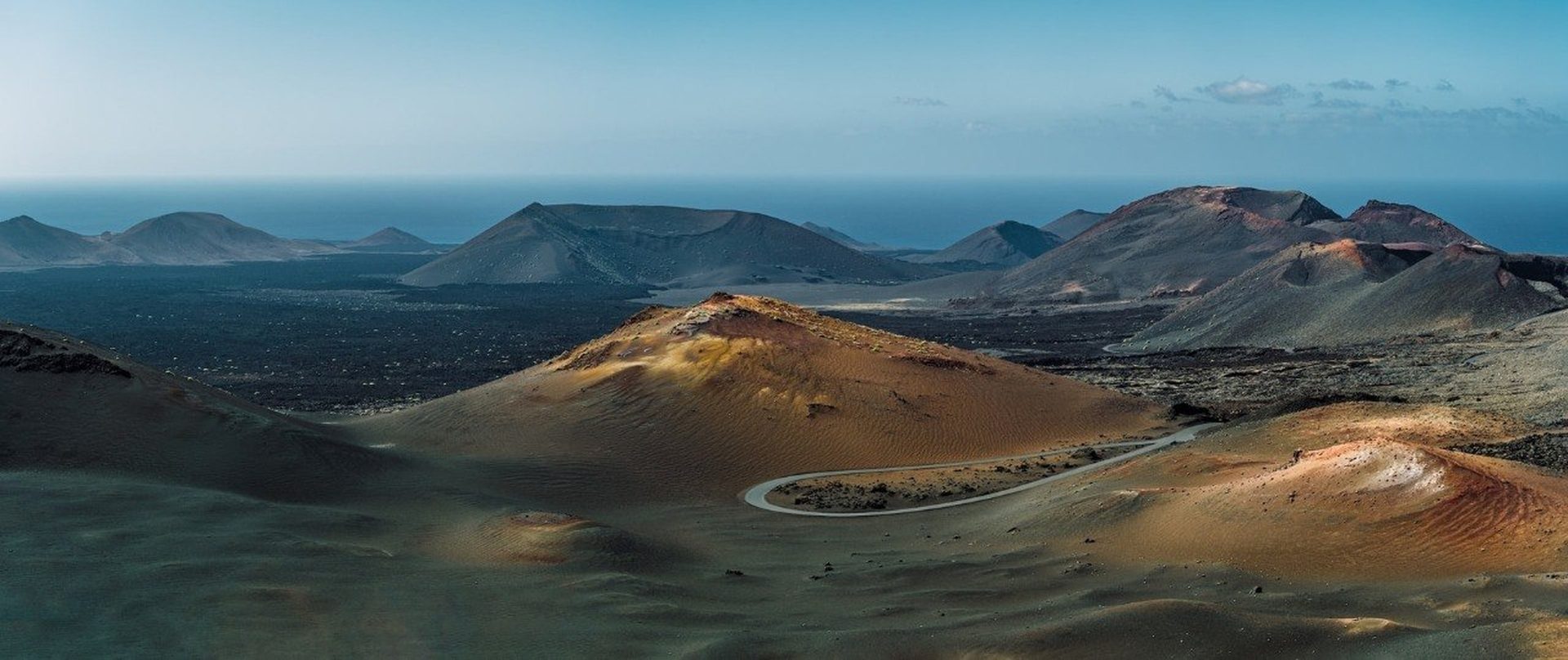
You don't just see Timanfaya. You feel it. The moment you step out of the car at the Montañas del Fuego visitor centre, the heat rises through your shoes. They pour a bucket of water into a pipe in the ground and it explodes back out as steam three seconds later. The temperature just below the surface is 400°C. You're standing on a furnace.

The only way into the heart of the park is the Volcano Route — a 14-kilometre bus tour through a landscape that looks like Mars before Mars was Mars. The road twists through craters, lava tongues and ash fields you'd swear were still smoking. There's no walking inside — the terrain is too fragile, too hot, too alien. The bus windows are your only barrier between you and a landscape that was on fire just 300 years ago.

Go first thing in the morning — the queues by 11am are biblical. The bus tour is included in your ticket, narrated in Spanish, English and German. Eat at El Diablo afterwards, the restaurant where they grill chicken over a volcanic vent. Yes, really. It's a gimmick, and it's brilliant.
Price: €30 adults — online only, no box office · Open: 9:30–17:30 · Car essential
S01
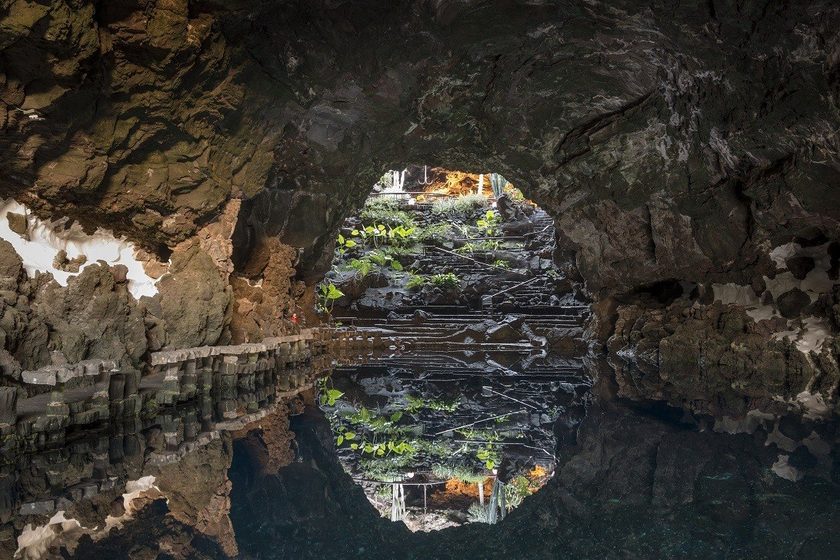
Jameos del Agua Lanzarote — Cesar Manrique underground volcanic cave with turquoise natural pool, palm trees and white architecture

Jameos del Agua — Manrique's underground cathedral

This is where the César Manrique story begins. In 1966, the artist looked at a collapsed lava tube in the north of the island and saw not a hole in the ground but a concert hall, a swimming pool and a bar. He built stairs into the darkness, planted palm trees inside a volcano, and turned a geological accident into the most surreal night out you'll ever have.

You descend into Jameo Chico, then cross a natural lake inhabited by tiny blind albino crabs — munidopsis polymorpha, found nowhere else on Earth. Then you emerge into Jameo Grande: a 550-seat natural auditorium carved from basalt, where they still hold concerts. The acoustics are perfect. The temperature is constant. You forget you're underground.

The pool is pure fantasy — turquoise water, white curves, strictly decorative. You can't swim. You can only stare. Go late afternoon when the tour buses have left. The light through the volcanic ceiling around 5pm is something you'll photograph and never quite capture.

Price: €17 adults (€22.40 with Casa de los Volcanes) · Open: 10:00–18:00 daily · Parking: Free
S02
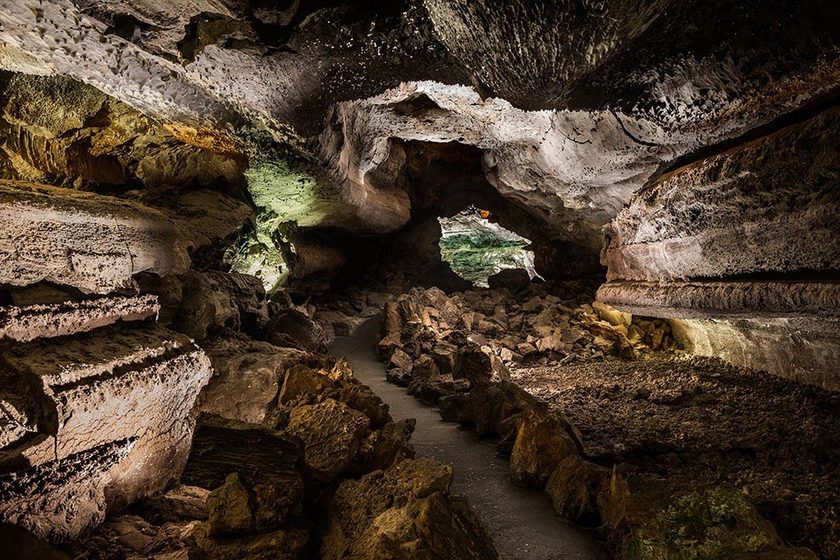
Cueva de los Verdes Lanzarote — volcanic lava tunnel interior with textured basalt walls, warm ambient lighting and natural rock formations

Cueva de los Verdes — the secret lava tunnel

One kilometre of lava tube open to visitors, part of a 6 km tunnel formed ~3,000–5,000 years ago when the Monte Corona volcano erupted. This isn't a cave — it's a tunnel carved by molten rock racing towards the sea. The guided tour takes about 45 minutes. You'll walk through chambers with 50-metre ceilings, past walls that shimmer green and red under carefully placed lights, and reach a point where the tunnel splits — one branch now houses Jameos del Agua, the other continues deep under the Atlantic.

The highlight comes at the end, and I won't spoil it — let's just say there's an optical illusion involving a perfectly still pool of water that has made grown adults gasp. The guide will ask you to look down. Do it. You'll understand.

Combine this with Jameos del Agua — they're literally part of the same volcanic tube, a 5-minute drive apart. There's a combo ticket that saves a few euros. Wear trainers, not flip-flops. The floor is uneven volcanic rock and the cave is cool year-round — a relief in August, bring a jumper in January.

Price: €17 adults — online only, no box office · Open: 9:30–16:15 · Guided tour only
S03
Mirador del Rio Lanzarote — Cesar Manrique cliff-top viewpoint with panoramic Atlantic Ocean views over La Graciosa island

Mirador del Río — the view that stops the conversation

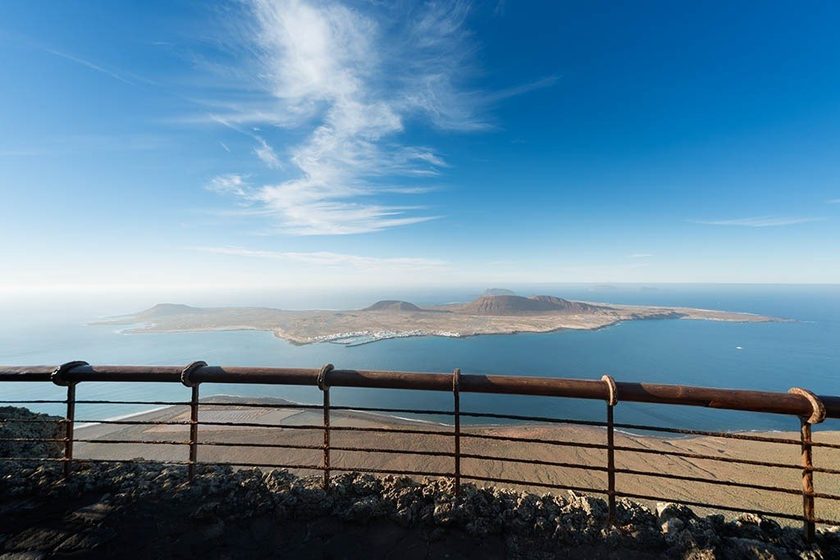
500 metres above sea level, on the edge of a cliff at the island's northern tip. Manrique carved this viewpoint into the rock in 1973, hiding it so well you can't see it from the road. You walk through a low doorway, turn a corner, and the entire Chinijo Archipelago opens up in front of you — La Graciosa, Montaña Clara, Alegranza, all floating in a sea that looks photoshopped blue.

The interior is pure Manrique: curved white walls, built-in seating, vast floor-to-ceiling windows. There's a café. Have a coffee. You won't want to leave. The wind up here is part of the experience — it whips across the cliff edge and reminds you that you're standing on top of an ancient volcano looking down at islands most people will never set foot on.

Best around 11am when the morning haze has cleared but before the afternoon coaches arrive. Combine it with a drive through Haría and a late lunch in Arrieta — that's a proper northern route.

Price: ~€9 adults · Open: 10:00–17:45 · Bar with views (coffee ~€4)
S04
Fundacion Cesar Manrique Foundation Lanzarote — the artists home built inside five volcanic lava bubbles with palm trees and white architecture

Fundación César Manrique — the artist's home in a lava bubble

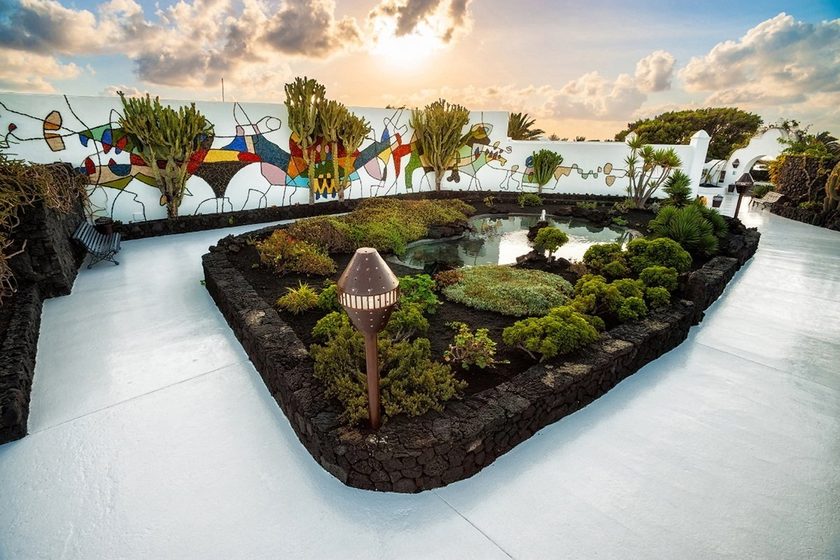
If you only visit one Manrique site, make it this one. His former home in Tahíche is built directly into a lava flow — five volcanic bubbles connected by tunnels, with a swimming pool, a dance floor and a palm tree growing through the living room ceiling. It's the purest expression of his philosophy: art and nature are the same thing.

You walk through his studio first, then down into the underground rooms where the lava shapes the walls. The contrast is deliberate — upstairs, sleek white modernity; downstairs, raw black volcanic rock with light pouring through skylights Manrique cut himself. His collection of works by Picasso, Miró and Chillida is scattered throughout, casually, like they're just part of the furniture.

It's in Tahíche, 10 minutes from Arrecife. Give yourself at least 90 minutes. The café in the garden is excellent — sit under the palm trees and let what you've just seen sink in. This isn't a house. It's a manifesto built in stone and light.

Price: ~€10 adults · Open: 10:00–18:00 daily · 90 min minimum
S05
Jardín de Cactus Lanzarote — terraced cactus garden with hundreds of species in a restored volcanic quarry under blue Canarian sky

Jardín de Cactus — 4,500 cacti in a volcanic quarry

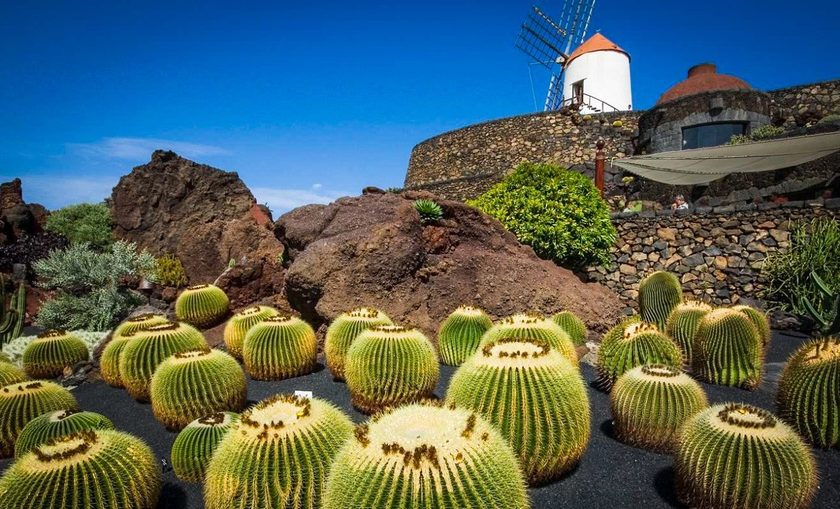
Manrique's last major work, opened in 1990, and perhaps his most joyful. He took an abandoned volcanic sand quarry in Guatiza — an industrial scar on the landscape — and filled it with 4,500 cacti from five continents. A giant metallic cactus sculpture greets you at the entrance. You walk down into a green amphitheatre where every plant looks sculpted by hand.

The design is classic Manrique: curved pathways, black volcanic stone contrasting with green spikes, a restored windmill standing guard at the top. It's smaller than you expect — you can see everything in 45 minutes — but it's perfectly proportioned. Every cactus has room to breathe, every viewpoint is intentional.

Combine it with a coffee in the village of Guatiza or add it to a northern loop with Jameos and Cueva de los Verdes — it's en route. Best in the morning when the light hits the quarry walls and the cacti cast long shadows.

Price: ~€9 adults (check cactlanzarote.com) · Open: 10:00–17:00 daily · 45 min visit
S06
El Golfo Lanzarote — emerald-green Charco de los Clicos lagoon inside a volcanic crater separated from the Atlantic by a black sand beach

El Golfo & Los Hervideros — green lagoon and the boiling sea

Two wonders, zero euros. El Golfo is a half-submerged volcanic crater whose centrepiece is Charco de los Clicos — an emerald-green lagoon separated from the Atlantic by a black sand beach. The green colour comes from algae that thrive in the mineral-rich water. You look at it from a clifftop viewing platform, and the contrast between green, black, blue and volcanic red is so intense it looks like someone turned the saturation slider to maximum.

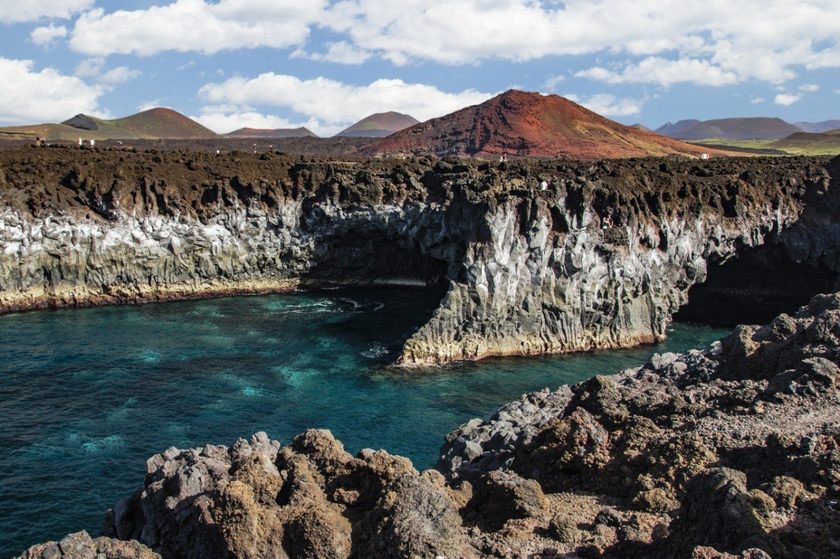
Two kilometres down the coast, Los Hervideros is where the ocean meets lava. When the swell is big — and it often is — waves crash through underwater caves and shoot up through blowholes in the rock. The name means "the boiling waters", and you'll see why. Stand on the viewing platforms (they're safe) and feel the spray on your face. On a rough day, the ground vibrates.

Best visited together — they're a 3-minute drive apart. Go late afternoon for the best light. Eat fresh fish afterwards in the village of El Golfo — Casa Torano and El Bogavante are solid choices right on the seafront.

Price: Free · Open: Always accessible · Best with swell for Los Hervideros
S07
La Geria Lanzarote — single Malvasía vines growing in volcanic ash craters protected by semicircular stone walls under blue sky

La Geria — wine country on black ash

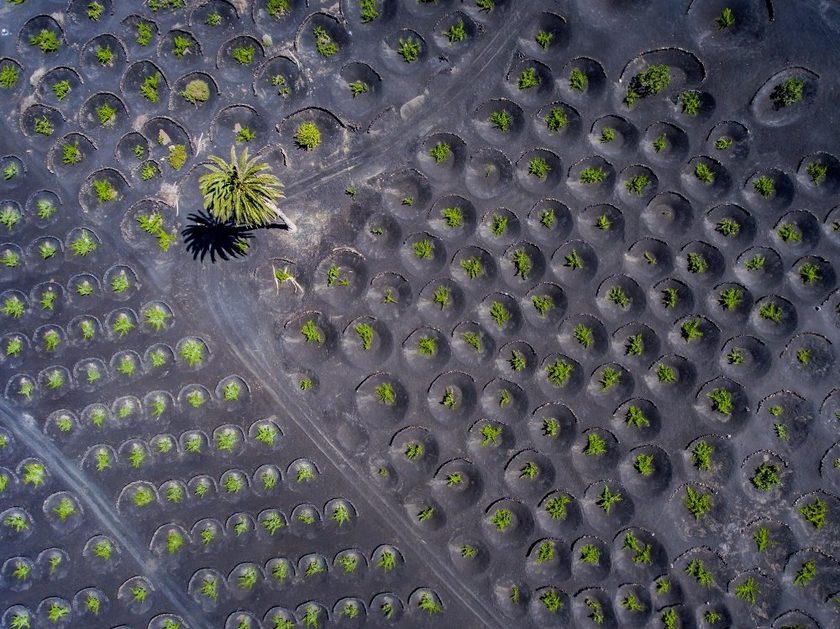
Take everything you know about vineyards and throw it out. La Geria doesn't have rolling green hills and neat rows of vines. It has black volcanic ash — picón — stretching to the horizon, with single vines planted in craters dug into the ash and protected by semicircular stone walls called zocos. It looks like a landscape designed by a surrealist who also enjoyed a good Malvasía.

The method is unique: the picón traps what little moisture arrives (Lanzarote gets about 150mm of rain a year), the zocos shield the vines from the wind, and the result is a wine unlike anything you've tasted — mineral, volcanic, slightly smoky. Bodega El Grifo is the oldest winery in the Canaries (1775) and does tastings from €10. Stratvs is the modern counterpart — slick architecture, excellent tour, slightly more expensive.

Drive the LZ-30 from Uga towards San Bartolomé — it's the most beautiful stretch of road on the island, with volcanoes on one side and a carpet of green vines on black ash on the other. Do a tasting mid-afternoon. You're on holiday. It's practically required.

Price: Free to explore · Wine tasting from ~€10 · Drive the LZ-30
S08
Playa de Papagayo Lanzarote — secluded golden sand cove with crystal-clear turquoise water and volcanic cliffs at the southern tip of the island

Playa de Papagayo — the beach you have to work for

Five golden coves at the southernmost tip of the island, inside the Los Ajaches Natural Park. There's a dirt road from Playa Blanca (about 6km, bumpy but passable in any car), a €3 barrier fee, and then you pick your beach. Papagayo itself is the largest and most famous. Playa de la Cera and Playa del Pozo are smaller and usually quieter. All of them have transparent turquoise water that looks borrowed from the Caribbean.

There are no sun loungers. No beach bars. No umbrellas for hire. Bring water, food, sunscreen and something to shade yourself. The nearest café is a 20-minute walk away. That's the point — these are beaches in their natural state, protected from the kind of development that lines the rest of the coast. The nudist crowd tends to colonise the eastern-facing coves, families cluster around Papagayo.

Go early — by midday in summer the car park fills up and the barrier closes. The light is best in the morning anyway, and you'll get a spot with a view. If the east wind is blowing, try the more sheltered western coves.

Price: ~€3 parking fee · Access: Dirt road from Playa Blanca · Bring everything you need
S09
Teguise Sunday market Lanzarote — whitewashed Canarian buildings and cobblestone streets of the former capital filled with artisan market stalls

Teguise Market — Sunday chaos in the old capital

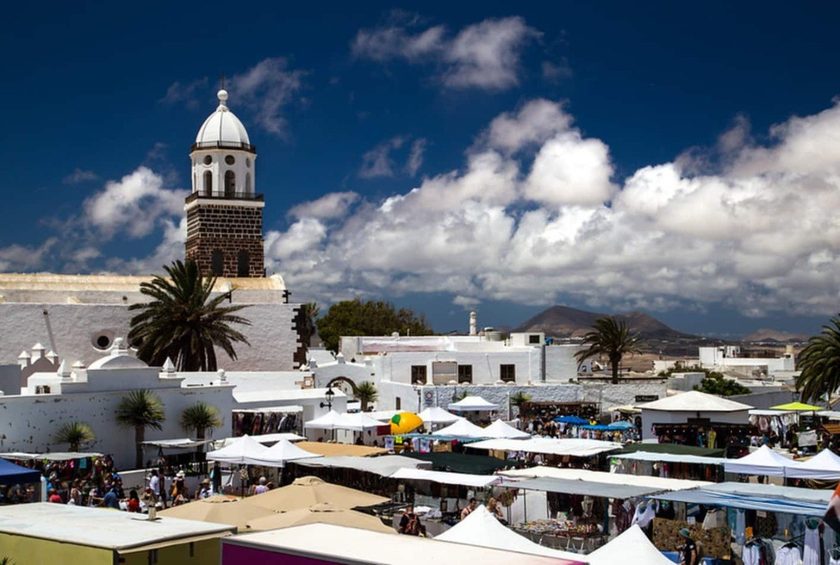
Every Sunday since 1985, the cobbled streets of Teguise — the island's former capital, a 600-year-old village in the centre of Lanzarote — transform into one of the largest street markets in the Canaries. Over 400 stalls selling everything from aloe vera products and Canarian cheese to leather goods, ceramics and jewellery that ranges from genuinely artisanal to distinctly suspect.

The market itself is the draw, but the village is worth seeing in its own right. Whitewashed 16th-century buildings, the church of Nuestra Señora de Guadalupe, and a handful of excellent cafés and tapas bars tucked into side streets. It gets crowded — tens of thousands of people every Sunday — so arrive before 10am if you want to park within walking distance. By noon the main square is a human traffic jam.

Eat at La Cantina or Acatife for proper Canarian food away from the market crowds. Buy the cheese. Skip the sunglasses. And if you find a stall selling barraquito — the layered Canarian coffee with condensed milk, Licor 43 and cinnamon — get one. It's the best €3 you'll spend all week.

Price: Free entry · When: Sundays 9:00–14:00 · Arrive before 10am for parking
S10