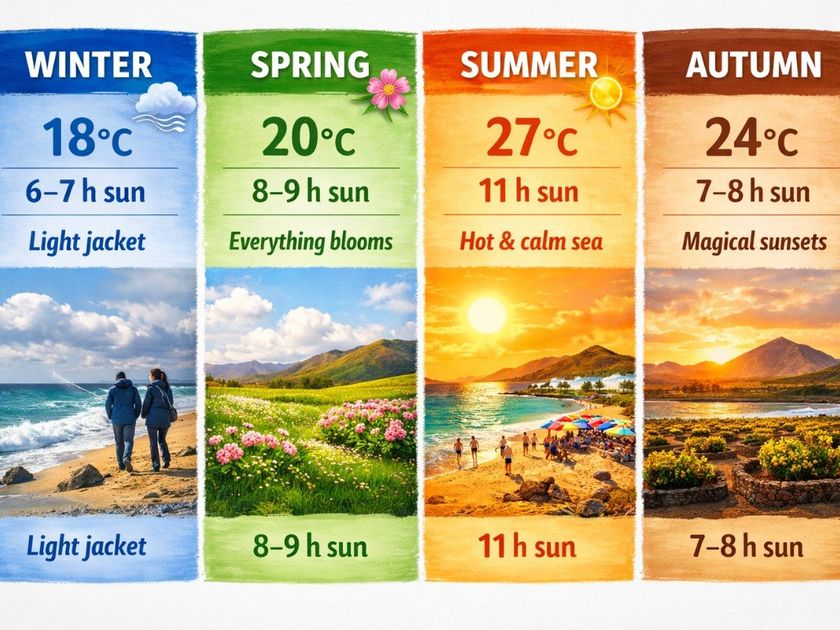
Why Lanzarote's weather is unlike anywhere else
Lanzarote sits at roughly 29° North — the same latitude as the Sahara, Florida and the Bahamas. You'd expect tropical heat. Instead, the island averages a mild 21°C year-round, never freezing, never sweltering. That strange gentleness isn't luck. It's the product of three forces fighting each other over the island every single day: the Sahara to the east, the cold Atlantic Canary Current to the west, and the Alisio trade winds blowing steadily from the northeast.
The Sahara wants to cook the island. The Atlantic wants to cool it. The trade winds act as the referee, pushing cool ocean air across the island most of the year and keeping temperatures remarkably stable. When the referee falls asleep and the Sahara gets its way, you get the calima — those orange, dust-laden days I'll explain in detail below. When the trade winds are at full strength, you get the breezy, sun-drenched conditions that made Lanzarote a windsurf and kitesurf destination.
Then there are the microclimates. Lanzarote is small — about 60 km north to south, 20 km across — but it packs wildly different conditions into that space. The north is greener, cooler and wetter. The south is drier, hotter and more sheltered. The central-eastern coast catches the trade winds head-on. Drive 30 minutes and the weather can change from "needs a jacket" to "needs sunscreen." I'll break down each microclimate further down.
The short version: Lanzarote genuinely is one of the most pleasant year-round climates in Europe. But "year-round pleasant" doesn't mean "year-round identical," and understanding the variation is the difference between a great trip and a disappointing one.
Month-by-month weather table
Here's the data, month by month. All figures are long-term averages from the AEMET station at Arrecife Airport. "Wind" is the typical daytime prevailing wind speed; calima days are excluded from averages because they skew everything.
| Month | Avg High °C | Avg Low °C | Sea °C | Sun hrs/day | Rainy days | Wind |
|---|---|---|---|---|---|---|
| January | 21 | 14 | 19 | 7 | 4 | Gusty |
| February | 21 | 14 | 18 | 7 | 3 | Gusty |
| March | 22 | 15 | 18 | 8 | 2 | Breezy |
| April | 23 | 16 | 19 | 9 | 1 | Breezy |
| May | 24 | 17 | 20 | 10 | 0 | Breezy |
| June | 26 | 19 | 21 | 11 | 0 | Strong |
| July | 27 | 20 | 22 | 11 | 0 | Strong |
| August | 28 | 21 | 22 | 10 | 0 | Strong |
| September | 27 | 20 | 23 | 9 | 1 | Breezy |
| October | 25 | 19 | 22 | 8 | 2 | Breezy |
| November | 23 | 17 | 21 | 7 | 3 | Breezy |
| December | 21 | 15 | 19 | 7 | 4 | Gusty |
The Calima — when the Sahara moves in
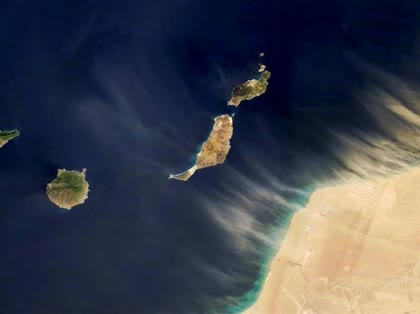
The calima is the weather phenomenon every visitor should know about, even if they never experience one. It's the reason "Lanzarote in summer" isn't always the postcard you booked.
Normally the trade winds blow from the northeast, dragging cool, moist Atlantic air across the island. But every so often — most often between July and September, though it can happen any month — the wind shifts and comes from the southeast instead, straight off the Sahara. That air is hot (often 35°C or more at the coast, sometimes hitting 40°C in extreme episodes), bone dry, and loaded with microscopic dust particles. The sky turns a muddy orange-grey. Visibility drops to a few hundred metres. The sun becomes a dim orange disc. Everything — cars, balconies, washing left outside — gets a fine film of brown dust.
A typical calima lasts 1–2 days. Severe episodes can run 4–5 days, but those are rare. The island averages around 24 calima days per year, so the odds of your week being fully ruined are low — but they're not zero.
What the calima means for you
- Health: Not dangerous for healthy adults, but the dust irritates eyes, throats and sinuses. If you have asthma, COPD or any respiratory condition, stay indoors with windows shut and run an air purifier if you can. The local health advice during severe episodes is to avoid outdoor exercise, drink plenty of water, and keep children and elderly people inside.
- Activities: Beach days become uncomfortable — the heat is oppressive and there's no cooling wind. Hiking is a bad idea. Swap to indoor sights: Jameos del Agua, Cueva de los Verdes, the César Manrique Foundation, the El Grifo wine museum. They're all underground or indoors and genuinely excellent.
- The upside: Calima sunsets are the most spectacular you'll ever see. The dust scatters the light into deep scarlets and burnt oranges that you simply don't get on a clear day. If there's a calima, find a west-facing spot for sunset.
- Forecasting: You can't predict a calima more than a few days ahead. Check calimacanarias.com or the AEMET forecast before and during your trip. The good news: they pass quickly.
The Alisio trade winds — how they shape the island
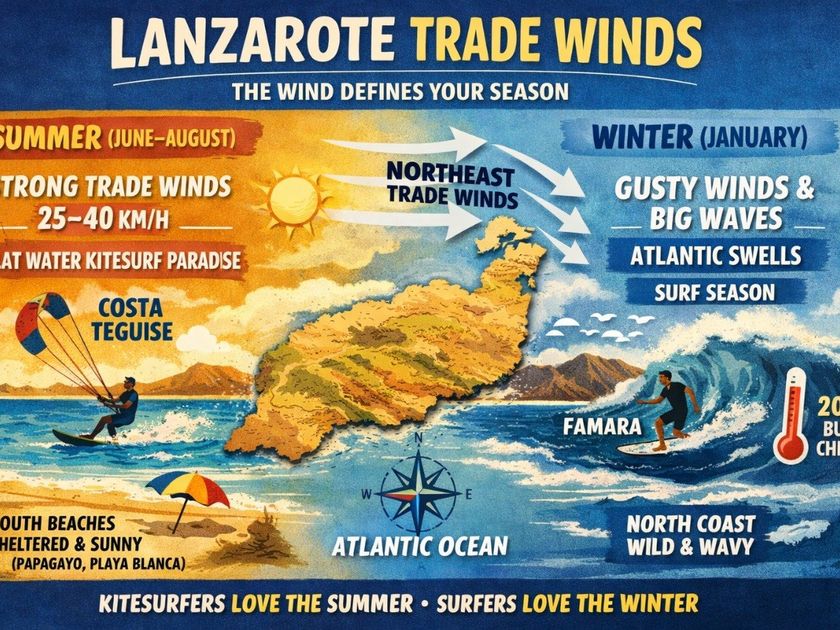
The Alisio — the northeast trade winds — are the single most important weather feature on Lanzarote, and most travel guides barely mention them. These winds blow from the northeast, day after day, driven by the pressure difference between the Azores high and the equatorial low. They're the reason the island is pleasant in summer instead of baking, and the reason Lanzarote became a world-class kitesurf and windsurf destination.
From June to August the trade winds are at their strongest — constant 25–40 km/h from the northeast, sometimes gusting higher. This is peak season for kitesurfers and windsurfers in Costa Teguise and at Famara. The wind is reliable enough that schools can guarantee lessons most days. For non-surfers, the trade winds are what keep summer bearable: 27°C with a 30 km/h breeze feels warm and pleasant, not oppressive.
In winter the trade winds weaken but never disappear. The Atlantic storm track moves south, bringing gusty, changeable conditions and ocean swells to exposed beaches. Red flags are common on north-facing beaches from November to March. The wind in winter is colder and less constant — it can drop to a calm, sunny morning and pick up to a brisk 25 km/h by afternoon.
The wind also shapes the landscape you came to see. The low, curved stone walls (zocos) protecting individual vines in La Geria are windbreaks — without them, the vines would be sandblasted by the trade winds. The sparse, sculptural vegetation on the north and east coasts is wind-pruned. Even the famous white houses with green wood trim are partly a response to the wind: low-profile, thick walls, small windows facing away from the prevailing direction. The Alisio isn't just weather here — it's architecture, agriculture and culture.
Practical tip: if you hate wind, base yourself in Playa Blanca (south) or choose south-facing beaches like Papagayo. The south coast is the most sheltered part of the island. If you love wind, Costa Teguise and Famara are where you want to be.
Best months for…
Different activities have different optimal windows. Here's the honest breakdown.
Beach & swimming
The sea is at its warmest (22–23°C), the air is still hot (25–27°C), and the crowds have thinned. July–August is good but packed and pricey.
Surfing
Winter Atlantic swells deliver the biggest, most consistent waves at Famara and the north coast. Bring a 3/2 mm wetsuit — the water is 18–19°C.
Kitesurfing
The trade winds blow 25–40 km/h almost every day. Costa Teguise (Las Cucharas) is the main spot. Warm water (21–22°C), no wetsuit needed.
Hiking & cycling
Summer is too hot for serious exertion midday. Winter and spring are ideal: 18–23°C, low humidity, green landscapes after winter rain.
Families with kids
Warm enough for the beach, calm seas, everything open, and prices are sane. Avoid August if you can — 28°C is hot for small children and everywhere is packed.
Budget travellers
The quietest, cheapest weeks of the year. Weather is still good (20–23°C, 7 sun hours). Flights, hotels and car hire all drop to low-season rates.
Remote workers
Cheap rent, empty coworking spaces, pleasant working temps (18–22°C). Bring a light jacket for evenings — the wind is real.
Photography
Dramatic skies, low light, occasional cloud. Summer skies are flat blue all day; winter has the texture and contrast that makes photos interesting.
Microclimates: north vs south vs central
This is the part most guides skip, and it matters more than you'd think on an island this small. The same day can feel like two different seasons depending on where you are.
The south — Playa Blanca, Papagayo, El Golfo
The south is the sunniest, warmest and most sheltered part of Lanzarote year-round. Playa Blanca sits behind a headland that blocks the prevailing northeast trade winds, so while Costa Teguise is getting sandblasted, Playa Blanca can be calm. The Papagayo beaches face south and are sheltered even on windy days — which is exactly why they're the most reliable swimming and sunbathing beaches in winter. If you're visiting in January or February and want beach days, stay south. The trade-off: the south is the most developed, resort-heavy part of the island.
The north — Haría, Órzola, La Graciosa
The north is the opposite: greener, cooler, breezier and wetter. The trade winds hit the north coast first, and the higher ground around Haría (the "valley of a thousand palms") catches moisture that the rest of the island never sees. This is why Haría is lush and green while the rest of Lanzarote looks like Mars. Temperatures run 1–2°C cooler than the south, the wind is stronger, and you'll see more cloud. It's beautiful, agricultural, and much quieter than the resorts — but it's not a winter beach destination. The north is for hiking, scenery, and escaping the crowds, not for sunbathing in February.
The central-east coast — Costa Teguise, Arrecife, Guacimeta
This is where the trade winds hit hardest. Costa Teguise was built specifically to catch the wind — it's a kitesurf resort, and the beach at Las Cucharas is designed around it. That's great if you're here to kitesurf; less great if you want a calm sunbathing day. The central coast is also where the airport is, so the weather data you see online (from Arrecife Airport) reflects this exposed eastern strip — which is breezier than the south and drier than the north. Arrecife itself is more built-up and slightly warmer than the coast around it, thanks to the urban heat island effect.
The west coast — Tinajo, La Santa, El Golfo
The west coast faces away from the trade winds and towards the open Atlantic. It's where the big Atlantic swells hit in winter, making it popular with surfers (La Santa, San Juan) and dramatic but not swim-friendly. El Golfo and the Los Hervideros coastline are where you'll see the raw power of the Atlantic — waves smashing into black volcanic rock. It's spectacular in any weather, but particularly dramatic when there's a winter swell running.
Practical packing tips by season
🌞 Summer (June – August): 26–28°C, strong wind, no rain
- T-shirts, shorts, light dresses — the basics. You won't need anything warm midday.
- A windbreaker or light hoodie for evenings. The trade winds make 21°C feel cooler than it sounds after sunset. This is the single most forgotten item.
- Reef-safe sunscreen, SPF 30–50. The UV index hits 11 in July — you will burn in 15 minutes without protection.
- Sunglasses and a hat with a chin strap (the wind will take a baseball cap).
- Swimwear, obviously. No wetsuit needed — the sea is 21–22°C.
- A light scarf — useful for dust if a calima rolls in.
🌸 Spring (March – May): 22–24°C, light wind, almost no rain
- Layers: T-shirts for midday, a light jumper or cardigan for mornings and evenings (15–17°C).
- A light jacket — not a thick one. Something that blocks wind but isn't too warm.
- Long trousers and a long-sleeved shirt for evenings. It won't be cold, but it won't be hot either.
- Walking shoes if you plan to hike — the volcanic terrain is rough on flimsy sandals.
- Swimwear — the sea is 18–20°C, fine for a quick dip but chilly for long swims. A shortie wetsuit helps if you're sensitive.
🍂 Autumn (September – November): 23–27°C, easing wind, occasional rain
- Still mostly summer clothes — September is genuinely hot (27°C). November drops to 23°C.
- A light rain jacket from November onwards. Rain is rare but when it comes it's heavy. An umbrella is overkill; a jacket is enough.
- Layers for evenings — November nights drop to 17°C with wind. You'll want a jumper.
- Swimwear — September and October have the warmest sea of the year (22–23°C). November is still swimmable at 21°C.
- Walking shoes — autumn is the start of hiking season. The landscape greens up after the first rains.
❄️ Winter (December – February): 21°C, gusty wind, occasional rain
- A proper windproof jacket. Not a down jacket — it's not that cold — but something that blocks the wind. This is the most important winter item.
- Layers underneath: a long-sleeve base layer, a fleece or jumper, and the windbreaker on top. You'll peel them off midday and put them back on by 5pm.
- Long trousers, not shorts. Jeans or chinos are fine.
- Closed shoes — sandals in January are optimistic unless you're on a sheltered south beach.
- Swimwear for the brave — the sea is 18–19°C. Most people find it cold but tolerable for 10 minutes. A 3/2 mm wetsuit makes it comfortable.
- A small umbrella or rain jacket. You'll probably not need it, but when you do you'll be glad.
Frequently asked questions
What is the best month to visit Lanzarote for warm weather?
For the warmest air and sea combined, September is the best month — air highs average 27°C and the sea reaches 23°C, its annual peak. May and October are close behind, with warm air, warm water and far fewer crowds than midsummer. July and August are the hottest on paper but also the most crowded and most expensive weeks of the year. If you want warmth without the hassle, aim for May, September or October.
How often does the calima happen in Lanzarote?
Lanzarote averages about 24 calima days per year, most often between July and September. A typical episode lasts 1–2 days. The calima is caused by hot, dusty air blowing from the Sahara to the southeast. It is not dangerous for healthy people but can irritate throats and eyes, and those with asthma or respiratory issues should stay indoors. You can check live forecasts at calimacanarias.com.
Does it ever rain in Lanzarote?
Yes, but very little. Lanzarote receives roughly 110–150 mm of rain per year, almost all of it between November and February. Most months see 1–4 rainy days, and when it does rain it tends to be short, heavy showers rather than all-day drizzle. From May to September there is effectively no rainfall. The island is semi-desert — that's why it looks the way it does.
Which part of Lanzarote has the best weather?
The south (Playa Blanca, Papagayo) is the sunniest, warmest and most sheltered part of the island year-round, protected from the prevailing northeast trade winds. The north (Haría, Órzola) is greener, cooler and breezier. The central and eastern coasts (Costa Teguise) catch the full force of the trade winds, making them ideal for kitesurfing but breezy for sunbathing. If you want guaranteed calm and warmth, stay south.
Is Lanzarote windy all year?
The northeast trade winds (Alisio) blow most consistently and strongly from June to August, averaging 25–40 km/h. They weaken in winter but never disappear entirely. Sheltered south-facing beaches like Papagayo feel calm even on windy days. If you are sensitive to wind, base yourself in Playa Blanca or choose a south-facing beach — and always pack a windbreaker.